


Yo! I'm an ABS plastic spool supplier, and today I wanna talk about the elasticity of an ABS plastic spool. You might be wondering, "Why does the elasticity of an ABS plastic spool even matter?" Well, stick around, and I'll break it down for you.
First off, let's get a basic understanding of what ABS plastic is. ABS stands for Acrylonitrile Butadiene Styrene. It's a common thermoplastic polymer that's known for its toughness, impact resistance, and good mechanical properties. These spools made from ABS plastic are used in a bunch of industries, like the cable and wire industry, for winding and storing cables.
Now, when we talk about the elasticity of an ABS plastic spool, we're essentially referring to how much it can stretch or deform under stress and then return to its original shape. Elasticity is measured by something called the elastic modulus. The elastic modulus gives us an idea of how stiff or flexible a material is. A high elastic modulus means the material is stiffer and doesn't deform easily, while a low elastic modulus indicates that the material is more flexible.

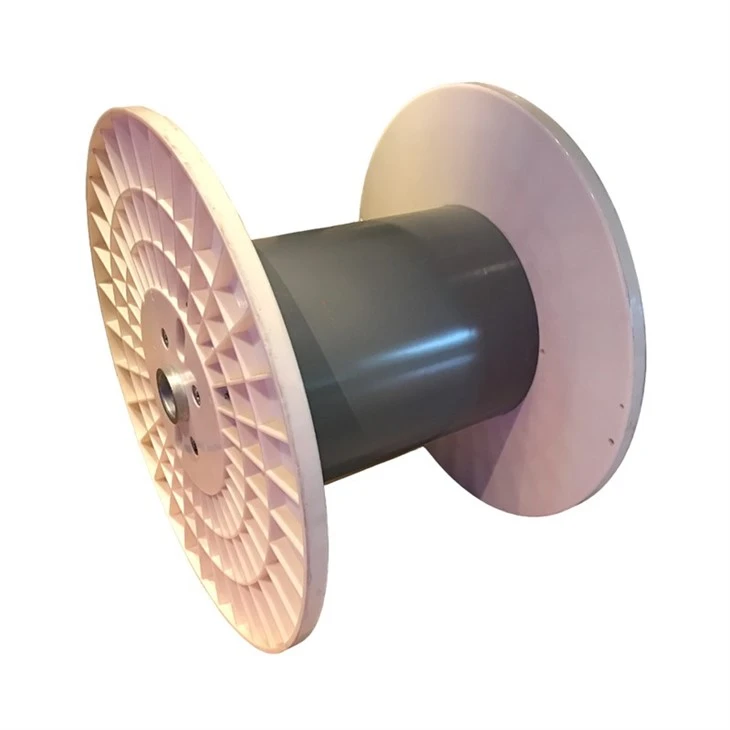
For an ABS plastic spool, its elasticity is crucial for several reasons. In the cable and wire industry, cables are wound and unwound from the spools multiple times. If the spool lacks the right amount of elasticity, it might crack or break under the stress of the winding and unwinding process. On the other hand, if it's too elastic, it could deform too much and not provide a stable base for the cable.
Let's dig a little deeper into the factors that affect the elasticity of an ABS plastic spool. One of the main factors is the composition of the ABS plastic itself. Different manufacturers might use slightly different formulations of ABS, which can result in variations in elasticity. For example, the ratio of acrylonitrile, butadiene, and styrene in the polymer can impact the material's properties. A higher proportion of butadiene generally makes the plastic more flexible and increases its elasticity.
The manufacturing process also plays a significant role. The way the spool is molded and cooled can affect its internal structure and, consequently, its elasticity. If the cooling process is too rapid, it might cause internal stresses in the spool, which can reduce its elasticity and make it more prone to cracking.
Temperature is another important factor. ABS plastic spools are often used in different environments with varying temperatures. At lower temperatures, the plastic tends to become stiffer and less elastic. This means that in cold conditions, the spool might be more likely to break if it's subjected to stress. On the other hand, at higher temperatures, the plastic becomes more flexible, but it might also lose some of its structural integrity.
So, how do we measure the elasticity of an ABS plastic spool? There are a few methods. One common method is a tensile test. In a tensile test, a sample of the ABS plastic is pulled at a constant rate until it breaks. The amount of force applied and the amount of deformation that occurs are measured. From these measurements, we can calculate the elastic modulus of the material.
Another method is a flexural test. In a flexural test, a spool or a sample of the plastic is bent to a certain degree, and the force required to bend it is measured. This test gives us an idea of how the spool will behave when it's subjected to bending forces, which is relevant in real - world applications.
As an ABS plastic spool supplier, I understand the importance of providing spools with the right elasticity. That's why we pay close attention to the composition of the ABS plastic we use, the manufacturing process, and the quality control measures. We make sure that our spools have the optimal elasticity to withstand the stresses they'll face in different applications.
If you're in the market for high - quality ABS plastic spools, check out our PN1000 ABS Bobbin. It's designed with the perfect balance of elasticity and strength to meet your needs. We also offer a wide range of Abs Plastic Spool options and Plastic Wire Spool Cable Reel products.
Whether you're in the cable and wire industry, electronics industry, or any other industry that requires reliable spools, we've got you covered. Our spools are made to last, and we're constantly working on improving their properties, including their elasticity.
If you're interested in learning more about our ABS plastic spools or have any questions about their elasticity or other properties, don't hesitate to reach out. We're here to help you find the best spool solutions for your business. Contact us for more information and to start a procurement discussion.
References
- Callister, W. D., & Rethwisch, D. G. (2010). Materials Science and Engineering: An Introduction. Wiley.
- Ashby, M. F. (2011). Materials Selection in Mechanical Design. Butterworth - Heinemann.