


Hey there! I'm a supplier of plastic cable drums, and I often get asked by customers about how to choose the right plastic cable drum based on cable diameter. It's a crucial question because using the wrong drum can lead to all sorts of problems, like cable damage, inefficient storage, and even safety hazards. So, in this blog post, I'm gonna share some tips and considerations to help you make the right choice.
First off, let's talk about why cable diameter matters. The diameter of your cable determines how much space it'll take up on the drum. If the drum is too small for the cable diameter, the cable might not wind evenly, leading to kinks and tangles. On the other hand, if the drum is too big, you're not using the space efficiently, and it can also be more difficult to handle and transport.
Measuring the Cable Diameter
Before you start looking for a cable drum, you need to accurately measure the diameter of your cable. You can use a simple caliper for this. Just place the caliper around the cable at its thickest point and read the measurement. Make sure to measure a few different sections of the cable to account for any variations. Once you have the diameter, it's a good idea to round up to the nearest millimeter to give yourself a little bit of wiggle room.
Understanding Drum Dimensions
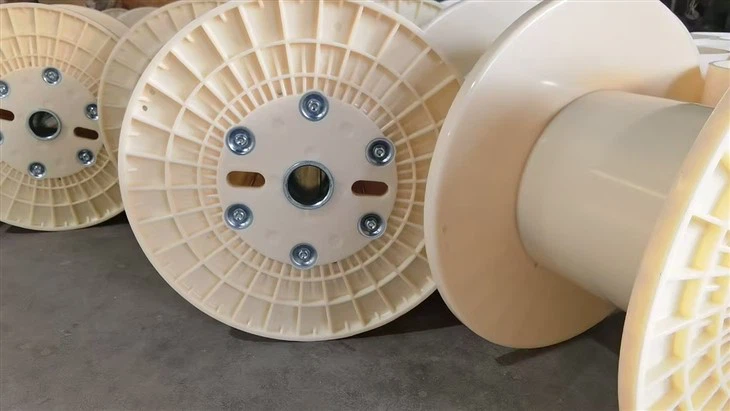
When it comes to plastic cable drums, there are a few key dimensions you need to pay attention to: the inner diameter, the outer diameter, and the width.
The inner diameter is the size of the hole in the middle of the drum. This needs to be large enough to fit the cable spooling equipment or the axle that the drum will be mounted on. As a general rule, the inner diameter should be at least 3 to 5 times the cable diameter. For example, if your cable has a diameter of 10 mm, the inner diameter of the drum should be around 30 to 50 mm.
The outer diameter of the drum is important because it determines how much cable you can wind onto it. A larger outer diameter means you can store more cable. You can calculate the approximate length of cable that can fit on a drum using a formula, but it's also available in most drum manufacturer's specifications.
The width of the drum is also crucial. It should be wide enough to accommodate the cable layers without causing them to overlap or bunch up. A good rule of thumb is to have the width of the drum be at least 1.5 to 2 times the cable diameter.
Material and Quality
Now, let's talk about the material of the plastic cable drum. At our company, we mainly use high - quality plastics like ABS (Acrylonitrile Butadiene Styrene). ABS is a great choice because it's strong, durable, and resistant to impact, chemicals, and UV rays. It can withstand harsh environmental conditions, which is important if your cables are going to be stored outdoors or in industrial settings.
For an Empty ABS Plastic Wire Reel, you're getting a product that's designed to last. It has a smooth surface, which helps the cable wind on and off easily without getting snagged. And because it's made of plastic, it's lighter than metal drums, making it easier to handle and transport.
Consider the Cable Type
Different types of cables have different characteristics, and this can also affect your drum choice. For example, some cables are more flexible than others. Flexible cables can be wound more tightly on a drum, so you might be able to use a drum with a smaller outer diameter. On the other hand, rigid cables need more space to be wound properly, so you'll need a larger drum.
Also, think about the insulation of the cable. If the cable has a thick insulation layer, it'll take up more space on the drum. Make sure to account for this when choosing the drum dimensions.

Compatibility with Equipment
Another important factor is the compatibility of the cable drum with your cable handling equipment. If you're using automated cable spooling machines, the drum needs to fit properly into the machine. Check the specifications of your equipment to ensure that the drum's inner diameter, outer diameter, and width are compatible.
Capacity Requirements
How much cable do you need to store? This is a critical question. If you only need to store a short length of cable, you can choose a smaller drum. But if you have a large amount of cable, you'll need a bigger drum. You can calculate the capacity of a drum based on its dimensions and the cable diameter. However, it's always a good idea to leave some extra space on the drum, especially if you might need to add more cable in the future.
Cost - Benefit Analysis
Of course, cost is always a consideration. You don't want to overspend on a drum that's too large for your needs, but you also don't want to skimp on quality and end up with a drum that doesn't work well. Compare the prices of different drums based on their size, material, and features. Sometimes, it might be worth spending a little more on a high - quality drum that will last longer and perform better.
Conclusion
Choosing the right plastic cable drum based on cable diameter is not as simple as it might seem at first. You need to consider multiple factors, including the cable diameter itself, the drum dimensions, the material, the cable type, compatibility with equipment, and your capacity requirements. By taking the time to carefully evaluate these factors, you can ensure that you choose a drum that will work well for your cables, protect them from damage, and make your cable storage and handling more efficient.
If you're still not sure which plastic cable drum is right for you, don't hesitate to reach out. We're here to help you make the best choice for your specific needs. Whether you have a small project or a large - scale industrial application, we have a wide range of plastic cable drums to suit your requirements. Contact us for more information and to start a procurement discussion.
References
- General guidelines on cable drum selection from industry handbooks.
- Manufacturer's specifications for plastic cable drums.